24.6 C
Monrovia
Thursday, July 2, 2026
Home Tags Sinoe County

Tag: Sinoe County

Loan Clubs Help Farmers Save Money and Forests

Members of Najor Village Saving and Loan Association

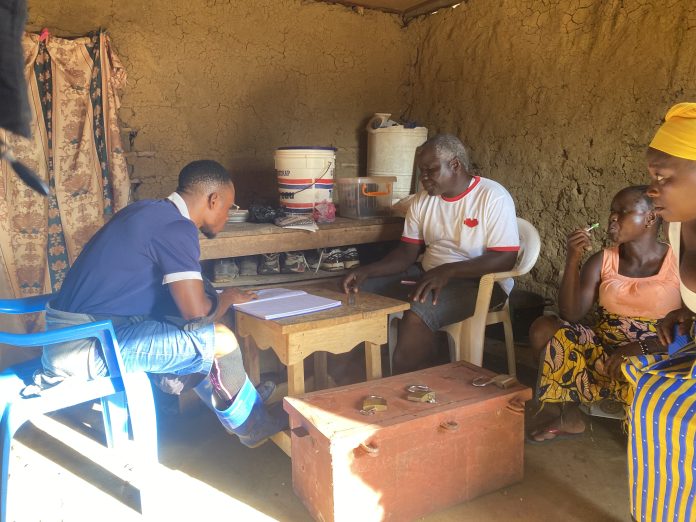
Top: Some members of the club met at their meeting in Diyankpo Town, and a staff member of the Integrated Development Learning visited to take records. Photo credit: Tina S. Mehnpaine


By Tina S. Mehnpaine


NAJOR TOWN – Maybel Payne walks steadily along a dirt path, a tub of harvested chili peppers balanced on her head. She is hurrying, not to the market, but to a meeting that has become one of the most important parts of life in this small farming town.

Payne is the box keeper for Najor’s Village Savings and Loan Association (VSLA), known locally as a money club. She is the first to arrive, carrying the metal box that holds the group’s savings and records.

For most of her life, Payne farmed the way many people here do. She harvested, sold what she could, and used the money almost immediately for food, school costs, medicine, transport, and other basic needs. Saving was not part of the routine, partly because there was no bank nearby and partly because the money rarely lasted long enough.

Now, through the club, she and other townspeople save, borrow, and invest under a new conservation program. They can take a loan for their farms or use their savings in times of emergency. Daily life in Najor is shaped by distance, poverty and the forest. The town has no school, clinic, police station or electricity. Mobile network here is weak, and the road is difficult, especially during the rainy season. Motorbikes are often the only transport, and even those are not always available.

“It is helping us to stand on our own,” Payne says. “This savings club is good for us,” says Payne, a mother of nine. “We can now save and support our farms.”

Najor is one of 10 communities covering 7,131 hectares of forest being protected through the payment for stewardship, a project supported by the Irish government and implemented by Integrated Development Learning, a Margibi-based NGO. The project is an area-based payment initiative, though plans are underway to scale to result-based payment. Beneficiary communities have received $21,392 for protecting the forest.  The ten communities are situated within the Jeadea and Wedjah districts. For this reporting, we also visited Jarwee, Soloe, Gboyee, Gartee, Flahn, Konwonkpo and Diyankpo.
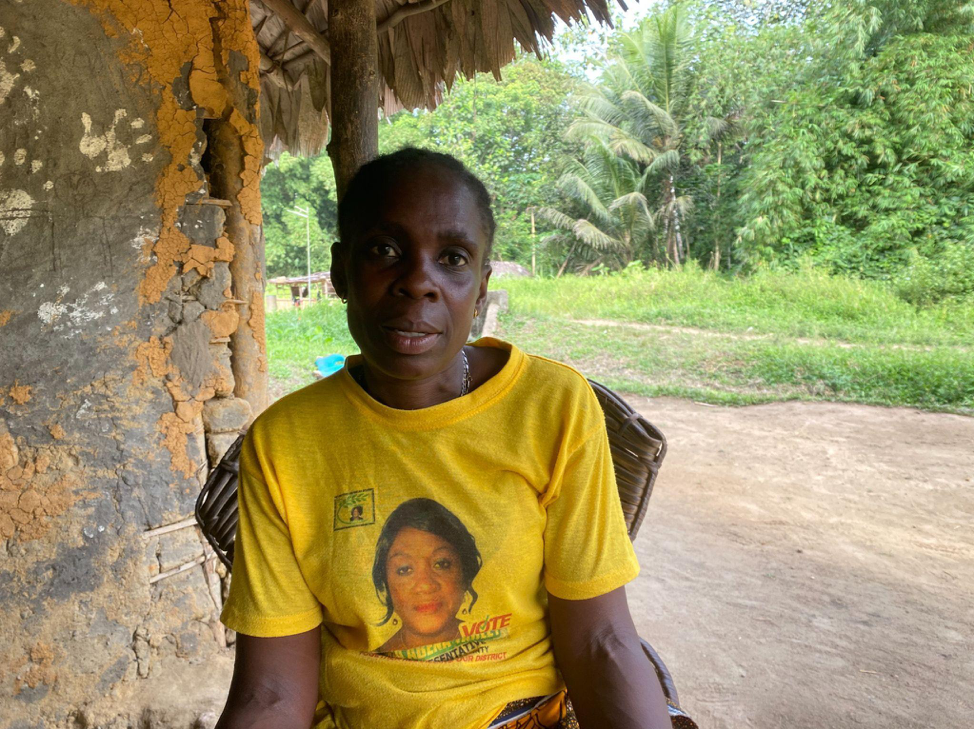
Maybel Payne
Maybel Payne sits in a rattan chair in Najor town. Photo credit: Tina S. Mehnpaine

The savings clubs were introduced in 2022 as a livelihood support, giving residents a way to build income, strengthen small businesses, and reduce dependence on forest resources. IDL provided training, metal boxes, padlocks, wall clocks, and stationery.

In an email, Bahnavileh Jones, who leads IDL’s small-business grant and savings programs, says linking conservation with savings is necessary because many projects fail to create sustainable income after donors leave.

“They also promote alternative livelihoods by enabling members to invest in small businesses, improved farming, or livestock,” Jones tells me. “VSLA funds can support environmentally friendly practices like agroforestry and sustainable farming.” He adds that access to savings and small loans can reduce pressure on forests by giving families other ways to meet urgent needs.

In communities like Najor, those needs are constant. Roads worsen with heavy rainfall. Sick people must travel to other towns for treatment. Children must leave the community to attend school. Farmers depend on cassava, pepper, beans and other crops, but getting produce to market remains costly.

For Payne, the change started in 2025 when the program reached Najor. After earning L$8,000 from her harvest, she bought two shares in the club totaling L$1,200.

“The L$8,000 was plenty,” she recalls. “As soon as I got my money, I took out L$5,000. My children in Greenville are going to school, and I bought their physical education uniforms.”

Liberia’s forests are a precious jewel in the world, holding more than 40 percent of the Upper Guinea rainforests, West Africa’s largest remaining forests, home to endangered species. But for decades, these forests have been lost to illegal logging, farming, and deforestation.

Saah A. David, Jr., former National Program Coordinator of the Liberia Forest Sector Project, a defunct US$150 million national initiative to combat deforestation, supports paying communities to keep their forests standing. Najor’s forest is particularly important because it borders Sapo National Park, Liberia’s largest protected area and the country’s only national park.  Program and project

“Payment for standing forests has been a dream of our people and the world at large. Making it a reality is a dream come true,” says David, who says he was hired to work as a consultant for the payment for stewardship in the first two years. “The communities are excited. Working with them on meaningful/impactful projects with their money remains a little challenge.”

The loan scheme has expanded beyond Najor. It is now active in 43 communities in the southeast, benefiting 2,207 people—1,623 women and 585 men.

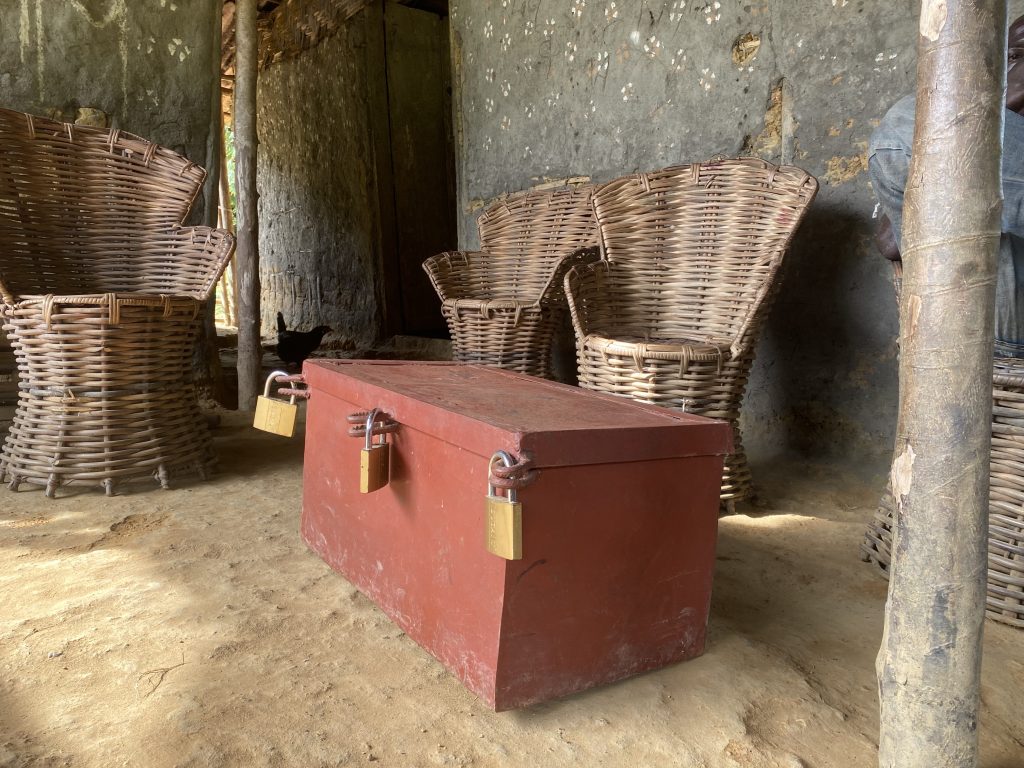
The clubs are owned and managed by the communities themselves. In each group, one person keeps the box, while three other people keep separate keys. The box can only be opened when all key holders, members, and leadership are present, and transactions are conducted in the presence of the full group. Money counters, a chairlady, and a chairman help manage the process.

“It is open to everybody; nobody can cheat,” says Oretha Swen from Jorwee Town.

In Jorwee, farming remains the main source of livelihood. Many residents produce gari, a processed cassava product. In the past, they grated cassava by hand and dried it for days. IDL later donated a processing mill to the savings club. Members pay a small fee to use the machine, and that money helps cover maintenance and repairs.

Other forms of support are also tied to the clubs. Some communities received motorbikes under a revolving scheme. A member receives a motorbike and makes installment payments until the full cost of 250,000 Liberian dollars is paid. Ownership then transfers to the member, and the group uses the money to buy a new motorbike for another member.

After each new motorbike is purchased, any remaining balance is divided between community development and the loan group. The group’s share is later distributed among members as part of interest earned at the end of the savings cycle.
IMG 5761
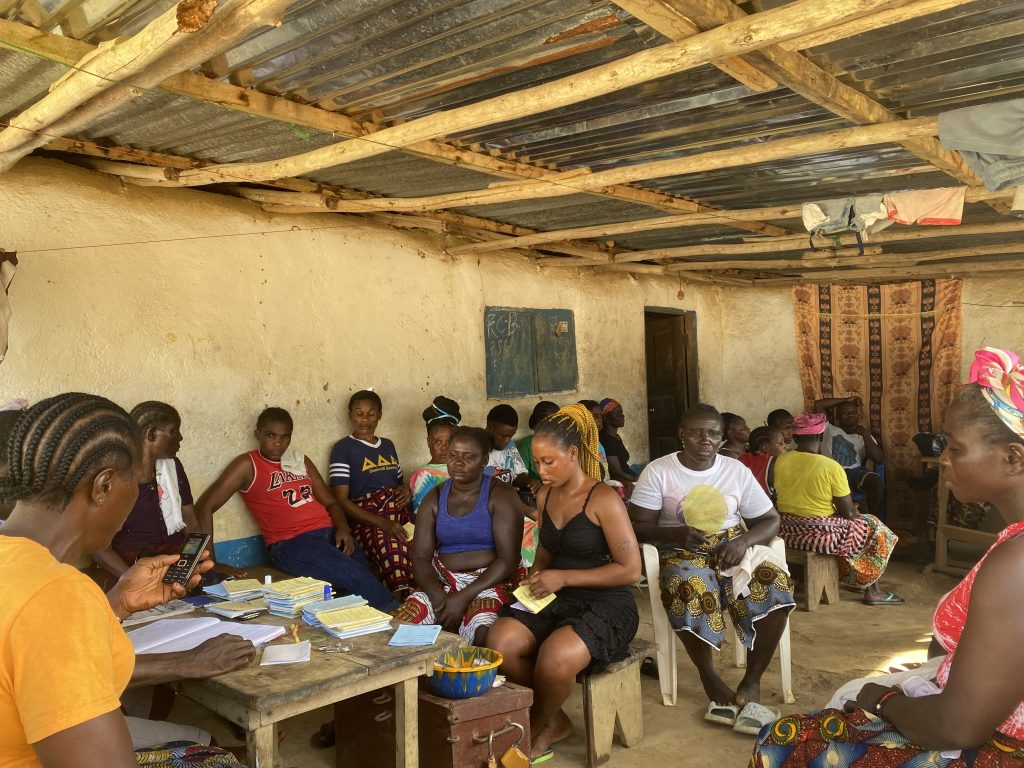
Members of the club at their Sunday meeting in Konwonkpo. Photo credit: Tina S. Mehnpaine

But the support does not solve every problem. Yatta Flahn, chairlady of Diayanpo Town, says the motorbike brought relief, but finding a reliable rider has been difficult.

“So we’re still keeping the bike,” she said.

IDL has also provided small business grants to club members who save regularly and repay loans on time. Jones says 148 members, including 123 women and 25 men, have received grants totaling L$6,436,820 (over US$35,700).

The grants help members expand existing businesses. First-cycle grants range from about L$35,000 to L$50,000. If members repay within three to four months with a five percent interest, they may qualify for a second round of US$75,000 to L$80,000. A third round of US$100,000 or more may follow, depending on the borrower’s business proposal and repayment record.

The club serves as guarantor. If one member fails to repay, no other member in that club can access another grant until the balance is cleared. The system is meant to build discipline and collective accountability.

For some residents, the club’s value goes beyond money. In farming communities, where people spend most of the day on their farms, meetings provide a rare opportunity.

“Most especially, it puts people together to discuss our town,” said Patrick Nimely of Flahn Town.

Nimely said the club has helped residents talk about conflicts, farming needs, and community development. IDL also donated seedlings, which farmers can plant and later replant on their own farms. Members, too, contribute 50 Liberian dollars to a social fund, which can be used when members are sick, getting married, or facing other needs.

Still, transportation remains one of the biggest barriers. Oretha Shepard from Jarwee Town, who received a small grant, says high transport costs reduce farmers’ earnings from gari and crops. A trip from Greenville can cost L$1,500.
IMG 5625
The metal box used in the village loan scheme has three locks, kept by two individuals who live separately. It cannot be opened in the absence of the two other keepers or the group. Photo credit: Tina Mehnpaine

“The transportation is too much, so we can’t see anything inside,” she laments.

Security is another concern. In towns without police, the metal savings box can become a target. Renee N. Gibson, program manager for the Rural Integrated Center for Community Empowerment (RICCE), recalls one incident in which a thief stole a money box while villagers were away farming. The community later found the box, but the money was gone. 

“What we’ve done now is transition to much larger, heavy-duty metal boxes,” Gibson said. “They are built so heavily that even two people cannot easily move them.”

For Payne, the box still represents something larger than cash. It is a sign that a town long lacking banks, roads, and basic services has found a way to save together, borrow together and plan together. The money club has become a small but practical form of security.


This story was a production of the Community of Forest and Environmental Journalists of Liberia (CoFEJ).

Sinoe Community Takes GVL Complaint to the EPA

Nitrain Lodges Complaint
Nitrain Lodges GVL Complaint to EPO

Top: Dennis Broh of Nitrian Community files a complaint against GVL with the EPA as SDI’s  Sampson Williams looks on. The DayLight/Harry Browne.


By Esau J. Farr


MONROVIA – The Nitrain Community Forest in Sinoe County has filed a complaint against Golden Veroleum Liberia (GVL) over alleged land grab and human rights abuses. Margibi-based NGO Sustainable Development Institute (SDI) filed the complaint on behalf of the community with the Environmental Protection Agency (EPA) in Monrovia recently.

“The Liberian government should ensure GVL restores the forests it has destroyed and provides measurable compensation for lands taken from communities without their consent,” said Dennis Broh, a Nitrain leader. “The forests of Liberia should benefit the people, not a company that treats the people and environment with contempt.”

The complaint alleges that GVL’s operations may violate several Liberian environmental laws. It called on the EPA to investigate and hold the company accountable. It accuses GVL of encroaching on Nitrain’s land, which it alleges violates the Land Rights Act and other laws.

In 2018, the Roundtable on Sustainable Palm Oil (RSPO) found GVL guilty of land grabs and other rights abuses in Sinoe. The RSPO mandated the Malaysian oil company to renegotiate with affected communities, but that has not happened.  

Nitrain
Established in 2011, Nitrain Community Forest covers 958 hectares in Sinoe County. The DayLight/Derick Snyder

Like RSPO, the High Carbon Stock Approach, which focuses on deforestation and climate change, confirmed in 2021 that GVL cleared 1,000 hectares of forestland in Nitrain without locals’ consent. It mandated GVL to restore the cleared forest area, but GVL has failed to do so, according to the complaint.

Nitrain said it was tired of waiting for international watchdogs to speak on its behalf. Now was the time to take action nationally. However, the community urged the EPA to collaborate with the RSPO and the HCSA in redressing the matter.

“It’s no secret that GVL has destroyed Liberia’s rich forests, grabbed land from communities, and failed to deliver on its promises…,” said James Otto, a lead campaigner at SDI.

“Despite being ordered to restore 1,000 hectares of forests it destroyed, GVL has not complied,” added Otto.  

GVL signed an agreement with the Liberian government in 2010 for 220,000 hectares of land for 65 years. The Indonesian palm oil company has the largest palm oil plantation in Liberia. Allegations of land grab and human rights abuses have marred its operations. GVL did not reply to queries for comments in this story. 

Court Fines 28 for Illegal Mining in Sapo Park

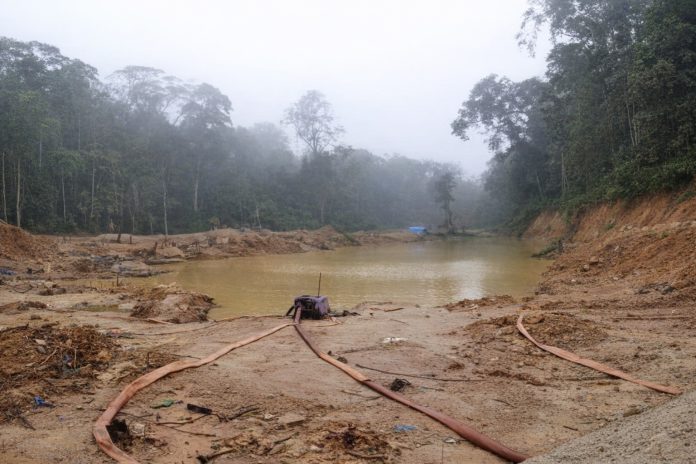
Top: An illegal mine in the Sapo National Park. File picture/Forestry Development Authority


By Myer Saydi


GREENVILLE – A court in Sinoe County has fined 28 suspects and ordered them to do community service for illegal mining in the Sapo National Park.  

The Greenville Magisterial Court fined the men US$1,300. It also ruled that they cut grass at the Presidential Palace in Greenville for seven working days.  

The suspects had pleaded guilty to theft of property and criminal trespass following their arrest in February by park rangers.  They escaped imprisonment because prosecutors did not prove they had any prior convictions for the crimes.

“I am happy for my clients despite government fines and community services because they are not going to jail,” said  Franklin Myers, the convicts’ lawyer. “The court ruling is not based on public sentiment but on what the law says. So, I am happy for them.”

John Smith, Chief Warden of the Sapo National Park, said the ruling would serve as a deterrent to illicit occupants. Smith added that Liberia’s protected areas are critical to biodiversity conservation. He urged citizens to respect conservation laws and support sustainable practices.

Joint security forces arrested the men in February 2026 during an enforcement operation, court documents show. Security forces seized 4.2 grams of gold, a half-filled 25-kilogram bag of rice, six gallons of gasoline and eight pieces of carpet.

Authorities reported that the group was actively involved in unauthorized mining, a direct violation of Liberia’s forestry, mining, environmental and wildlife laws.

The ruling comes amid ongoing efforts to curb environmental degradation inside Liberia’s largest park. To date, thousands of illicit occupants have been removed from the 697-square-mile park, one of the world’s biodiversity hotspots.


This story is a production of the Community of Forest and Environmental Journalists of Liberia (CoFEJ).


Cocoa Changing Lives but Destroying Grand Gedeh’s Largest Forest

default

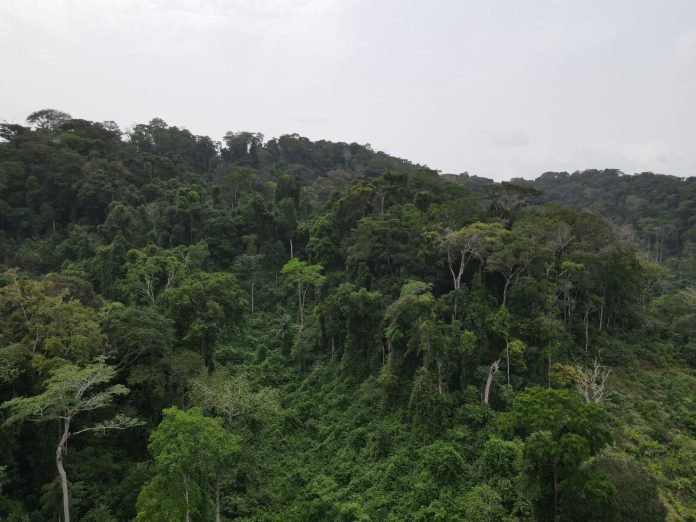
Top: A partial view of the Konobo Community Forest in Grand Gedeh County. The DayLight/Samuel Jabba


By Esau J. Farr   


BOUNDARY TOWN, Grand Gedeh County – Lawrence Koolor woke up one cool morning, his face beaming with a smile and joy pouring out of his heart. Koolor’s dream became a reality late last year when he moved his family into his new house. He had lived in his uncle’s house for decades.

Koolor built his home out of money he received from Burkinabé cocoa farmers he hosts in Konobo. His house—part-mud, part-concrete with metal roofs— stands out among huts with thatched roofs in Boundary, a town on the border between the Konobo and Tchien Districts in Grand Gedeh County.

“I felt so happy that day for me to go and live in my own house at that time,” recalls Koolor. “That was a complete relief for my family to [move from one bedroom] to a whole house.”

Koolor is one of several residents of Konobo, who, along with their Burkinabé guests, have encroached on Grand Gedeh’s largest remaining rainforest. Townspeople in Konobo say the arrival of Burkinabé cocoa farmers in their communities has transformed their lives.

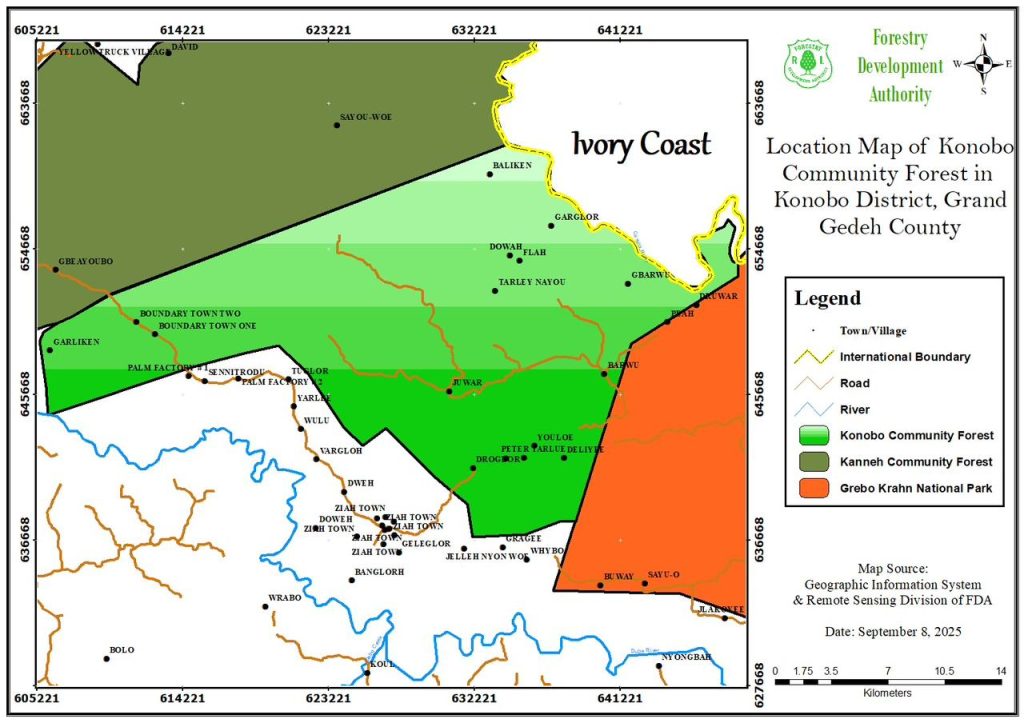
The map of Konobo. File photo/Forestry Development Authority

Konobo has 390,000 hectares of natural forest, according to Global Forest Watch, an application that tracks deforestation. Gbarzon and Tchein Districts are second to Konobo District in Grand Gedeh County, with higher rainforest, 360,000 hectares each.  

Burkinabés likely started migrating into Liberia from the neighboring Ivory Coast in 2014 in search of cocoa farmlands. The Liberia Immigration Service (LIS) has profiled 55,000 Burkinabés in southeast Liberia, 48,000 in Grand Gedeh. Burkinabés, also known as “Mossi,” have agreements with locals in which they provide investment and labor, while the locals provide land.

“The cocoa business that came here is helping to take us from zero to hero,” says Alice Doe, who hosts six Burkinabé migrant workers in Boundary Town.

“Before, we could not get a dime to buy a sheet of zinc. But for now, that story has changed, because before the Burkinabés enter your [forest], they give you [money],” adds Doe.

Interviews and reporters’ observations show Konobo District—a low-income community of 26,588 people—is transforming in several ways. People are earning income from cocoa that they have never earned in their lives. New houses are being built, and one resident is sponsoring his son’s studies in Spain.

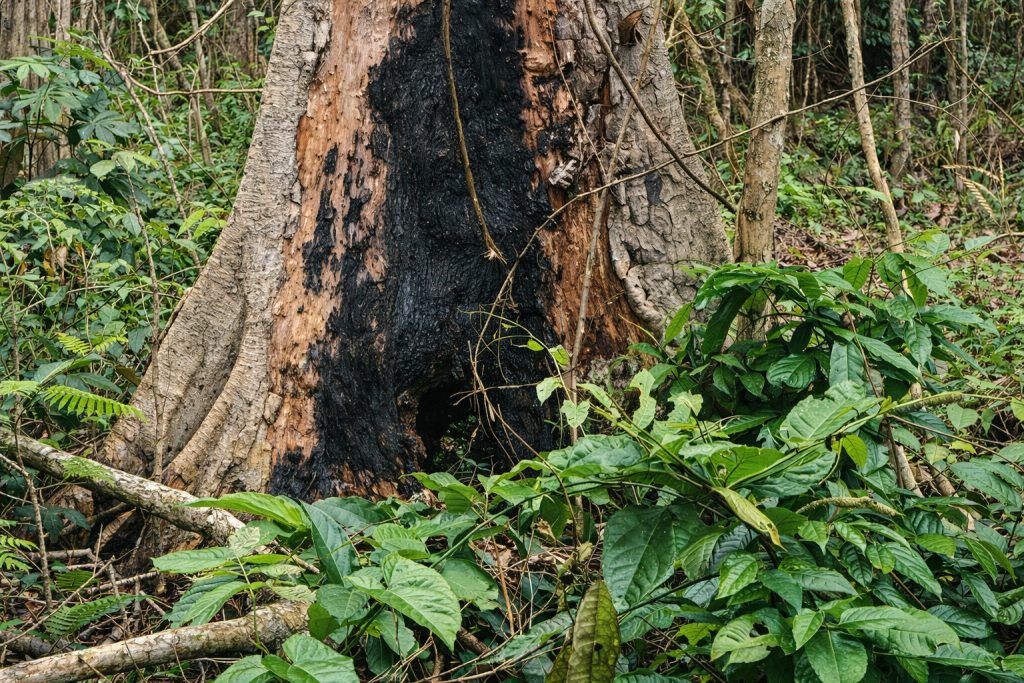
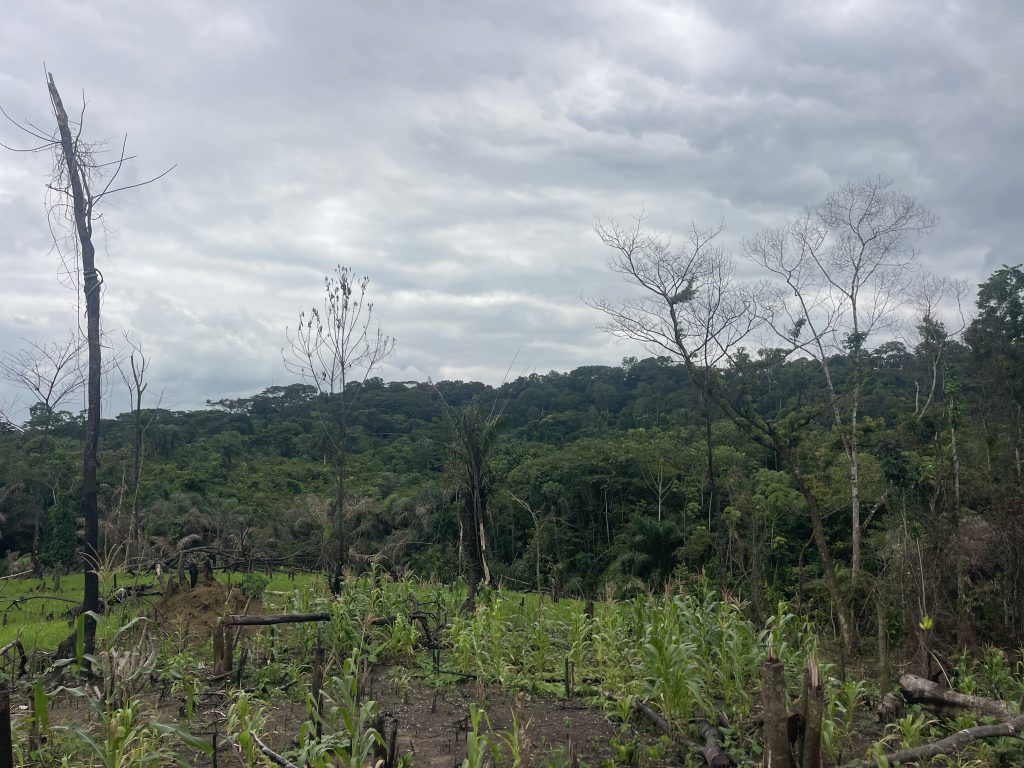
Cocoa farming might be transforming lives in Konobo, but it is wiping out the district’s forest. To plant cocoa, Burkinabés burn down the forest. Reporters saw trees losing their foliage, gradually morphing into woody skeletons.  

Between 2002 and 2024, Konobo lost 9,300 hectares of primary forest. A 2024 study found that 15 percent of Liberia’s deforestation is linked to cocoa cultivation. Then, last November, the London-based Global Witness linked top European chocolate makers to deforestation in Liberia.

‘Under threat’

Satellite imagery confirms that cocoa farmers are encroaching on the Konobo Community Forest, a 49,625-hectare woodland meant for logging. Konobo and the Forestry Development Authority (FDA) signed an agreement in 2020 to co-manage logging activities with the regulator. The agreement outlaws farming in the community forest.

And that is exactly the case. Drone shots show cocoa pods sprouting amid decaying trees and cultivated forests. 

“When the Burkinabés enter the forest, they burn all the trees…,” says Beyan Woi, FDA’s regional manager in Grand Gedeh. “Most of [those] community forests that people wanted to do logging and conservation in are under threat by Burkinabés.”

Burkinabé migrants set fire or apply chemicals to the base of trees in clearing the forest for cocoa cultivation.  File photo/Forestry Development Authority

Woi says the FDA has made efforts to curtail encroachment on forests in the southeast, including prosecution.  

Wulu Gaye, the chief officer of Konobo Community Forest, echoes Woi’s comments. The encroachment is the biggest challenge Gaye, who was recently elected, faces.   

“As we speak, the forest is not well protected. There are illegal farmers farming in the forest,” says Gaye.

Burkinabés-hosts in Konobo deny farming in the community forest, claiming the farmland was their private property.

“I have more than 20 Burkinabés working for me on more than a-kilo-hectare of our farmland here in Boundary Town,” said Dennis Jakar, a classroom teacher and a resident of Boundary Town. Jakar claimed he is using ancestral land for his cocoa farm.

The DayLight could not independently verify Jakar’s and other townspeople’s comments due to the distances to the farms and the security of the reporters. Furthermore, the newspaper could not identify the owners of the farms the drone captured.

However, farmers hosting the Burkinabés say people are farming in the community forest because logging has failed them. Their position is a reference to an inactive logging agreement locals have.

In May 2021, Konobo and Horizon Logging Limited, a Monrovia-based firm, signed a contract. Horizon agreed to construct health facilities, handpumps, and latrines in the affected communities in addition to land rental and harvesting fees. The company failed to carry out the projects, leaving behind unpaid debts and abandoned logs.  Horizon did not respond to queries for comment on the contract.

The contract’s failure is visible throughout Konobo. Several logs are abandoned in Boundary Town, behind a clinic and at other locations. Locals drink from creeks, and there are no public latrines.

“They (Horizon) lied to us; so, we were left with no other option but to put Burkinabés in the concession area to [farm for us],” says Christian Menyeah, a Konobo resident, who hosts three Burkinabé migrants.

“The money we are now getting from cocoa farming is plenty and quicker than what a logging company would give us,” adds Bill Yallah, a host of dozens of Burkinabés migrants.

Gaye, Konobo’s chief officer, says his leadership is working with county authorities to remove the encroachers from the community forest.

Gaye says, “Well, all the local authorities [bought] the idea that there’s a need that we remove the illegal farmers…”


Samuel T. Jabba contributed to this story.


This story was a production of the Community of Forest and Environmental Journalists of Liberia (CoFEJ).
New, Community-led Conservation Delivering Promises  

Top: The payment for stewardship enables communities to get direct cash benefits and livelihood programs for keeping their forests standing. The DayLight/Samuel Jabba


By Varney Kamara


MONROVIA – Years ago, women in Wedjah and Jaedae Districts in Sinoe County processed cassava with their bare hands. Their story has changed for the better. They now use motorized mills, locally called garri machines, to grind their cassava before processing it. The grinders significantly reduce their labor inputs while increasing production, enhancing their businesses and improving their livelihoods.

“Since it was introduced, women’s involvement in business activity in the community has increased. We see more provision shops being built,” says Wratee Boyee, a community leader in Jeadea District.

The flourishing cassava businesses are some of the results of a trial of a new conservation method known as payment for stewardship.  Launched last July, the program enables communities to receive direct cash benefits and livelihood interventions to help keep their forests standing. Experts say the program shows great potential to improve lives in rural communities, though it is too early to measure its full impact.

The program intends to protect between 300,000 and 500,000 hectares of forest, with a total investment of US$3.4 million by 2030. It is jointly implemented by Integrated Development and Learning (IDL), a Margibi-based NGO, and the Forestry Development Authority (FDA).

“FDA strongly believes that this project will lead to the enhancement of sustainable forest management, forest conservation, including legal compliance and enforcement,” said Myers Tweh Jr., assurance and compliance manager at the FDA.  “It will lead to the implementation of reward-based mechanisms that would reduce pressure on the forest.”

Under the trial, Wedjah is protecting 7,131 hectares, and Jaedae 43,543 hectares after meeting payment requirements. Both communities have received a combined payment of US$150,622 at the rate of US$1.50 per hectare yearly, according to payment records. Wedjah got US$21,393 for the two years the trial has been running, while Jaedae secured US$129,229 for the same period. Moreover, local forest guards receive training, a monthly compensation, protective gear, and GPS-programmed gadgets for monitoring.   

Both Wedjah and Jaedae are on the buffer with the Sapo National Park, Liberia’s largest protected area, and the Proposed Grand-Kru-River-Gee Protected Area. They host wildlife such as chimpanzees and other species typical of Liberia’s rainforest, the largest remaining in West Africa.

In exchange for cash and the other benefits, Wedjah and Jaedae do not mine, farm, log, or build new homes in their forests. They harvest timber and non-timber products for community use only. They signed an agreement last June.

Environmentalists say the payment for stewardship helps reduce local communities’ dependency on the forest resources and contributes to the fight against climate change. Between 2002 and 2024, Liberia lost 390,000 hectares of primary forest, according to the Global Forest Watch. Agriculture, logging, mining, illicit activities and a recent cocoa boom in the southeast are the contributors, undermining conservation efforts.  

Game-changer 

Payment for stewardship breaks away from the past, when communities were at the margins of conservation efforts. In contrast, the program places communities at the core of conservation efforts. They protect the forest and decide what to do with the resources.

“We ensured that no one was excluded from the process,” recalls Silas Siakor, the executive director of IDL, “because, when you exclude others, there is a natural tendency for a whole community to go against you.”

“We wanted to do something very simple: we wanted communities to be provided direct incentives to protect their community forests,” adds Siakor.

Overall, the stewardship is intended to develop a community-led benefit-sharing mechanism. Currently, that is the duty of the Benefit Sharing Trust Board, which regulates resources for logging concessions. However, the new program recommends a channel that incorporates mining, agriculture, and climate finance.

Similarly, the payment for the stewardship program readies communities for climate financing, environmentalists say. Liberia is developing a carbon policy framework.

An independent assessment reviewed the new program’s activities and payment performances, and found positive behavioral changes among locals.

The most visible success of the scheme comes from the investments in livelihood activities, largely driven by village loan groups that provide savings and low-interest loans to members. IDL works with more than 52  in Sinoe; 20 in Wedjah and Jaedae.

“In 2025 alone, the [village loan scheme] generated more than L$50 million (US$263,000) from their village saving activities, more than what the amount the communities received for keeping their forest standing,” says Silas Siakor.

A section of a farm on the edge of a forest in Jaedae District, Sinoe County, in 2025. The DayLight/Esau Farr

For the cassava processing, four machines have been strategically deployed in Wedjah, replacing the traditional method of grinding the cassava. The investment in livelihood is the primary attraction for women, according to Siakor.

In addition to the machines, Wedjah received three motorbikes to improve women’s access to the market and secure better prices for their garri.

“We see that women are forming more financial clubs in the community, the movement of goods and services has increased, and businesses are also flourishing,” Lasting Kadee, a community leader in Wedjah, said in an interview with The DayLight. “We want to give it out to them 100 percent for this program. It is really helping our people.”

Additional feedback

Despite the success stories, the independent assessment found the payment for stewardship to be “moderately strong” in that it was too early to grade the overall impact. The review took place six months into the program, needing more than to conduct a full-scale assessment. This, too, was compounded by bad weather and terrible road networks. 

However, the assessment was conclusive regarding the challenges associated with the payment for stewardship. It found that the youth and elderly townspeople disagreed on how potential land disputes could be settled.

Also, it found that townspeople in Wedjah and Jaedae faced difficulty meeting and agreeing on projects due to long distances between communities. Townsfolk said they did not afford transportation to attend meetings, the assessment revealed.

“We saw that planning for the project was a difficult thing to do because you cannot get everybody in one location at the same time,” says Saah David, an environmentalist who led the assessment. “Nevertheless, based on our interactions with the different actors, I think it is a game-changing initiative with a lot of potential.”

David’s report recommends that youth participation, coordination, and improvement in communication and compliance safeguards would address challenges.  It also recommends improvement in performance requirements and governance safeguards to meet the program’s challenges. 

To meet these challenges, IDL wants to engage communities and support local forest bodies for long-term success.

“We intend to organize more discussions around these issues,” says Siakor. “The idea is to generate additional feedback from the different stakeholders, so that we can derive effective solutions to those issues that have been identified.”

Community Forest Signs Logging Deal Amid Issues

Top: Seekon Pellokon Community Forest covers 44,989 hectares. The DayLight/Carlucci Cooper


By Emmanuel Davies


SEEKON PELLOKON, Sinoe County – A community forest has signed a logging contract with a company despite multiple reports highlighting problems with the deal.

The agreement green-lights the Liberian Hardwood Corporation to carry on logging activities in the Seekon Pellokon Community Forest in Sinoe County.

Signed on 10th September, the contract provides for a combined annual payment of US$47,930 to the community in exchange for the 44,989-hectare forestland. It provides for land rental fees, development initiatives, and education, among others, for landowning communities.

Several roads were captured for rehabilitation and maintenance throughout the lifespan of the contract. Liberian Hardwood to construct durable wooden and concrete bridges, the agreement shows.

It was signed a day after two DayLight reporters, Esau Farr and Carlucci Cooper,  narrowly escaped the wrath of a masked dancer, commonly known as “Country Devil.”

Reporters Farr and Cooper had traveled to conduct an investigation for a contract-signing ceremony in the Community Forest when they were suddenly confronted by the country devil.

Seekon Pellokon’s leaders were reacting to an investigation the online newspaper published. It highlighted issues and concerns about Liberian Hardwood’s capacity to operate Seekon Pellokon amid its failure in the Bloquia and Neezonnie Community Forests in Grand Gedeh, and its management of the largest active forestry concession in Liberia, covering Grand Gedeh and River Gee Counties, 254,670 hectares. The concession is known in the sector as the forestry management contract area-F (FMC–F).

Junior Kumah, a Seekon Pellokon leader, had dismissed the warning of Liberian Hardwood failure in Grand Gedeh.   Kumeh argued that they had signed a five-year contract, the company would pay after production, and they would terminate the contract if Liberian Hardwood breached the contract.

Pellokon Town in the Seekon District, Sinoe County. The DayLight/Esau J. Farr

“I am not a rocket scientist to know whether Hardwood will fail or not. All I am telling you is that what happened in Bloquia will not be repeated here. What happened to John doesn’t mean the same thing will happen to Paul,” Kumah said.

The investigation also shed light on the relationship between the company’s manager and co-owner, Jihad Akkari’s relationship with the Managing Director of the Forestry Development Authority (FDA), Rudolph Merab. The investigation accused Merab of negotiating for Akkari to get Seekon Pellokon.

“FDA is the one that is negotiating. The FDA has all those documents in its possession,” said Kumah in a phone interview.

“FDA said it would not do business with us unless the community signs a contract with Liberian Hardwood,” said Stanley Kreejarly, a Seekon Pellokon leader, confirming Kumah’s claim.

Merab did not respond to The DayLight queries for comments on the accusations. However, Akkari denied any wrongdoing. In a statement, he claimed he had lost US$4 million in Grand Gedeh, and had “the capacity to operate” the combined nearly 300,000 hectares of Seekon Pellokon and FMC – F.


This story was produced by the Community of Forests and Environmental Journalists of Liberia (CoFE).

Gov’t Ignored Offenses, Now Logging Firm Fades

#image_title

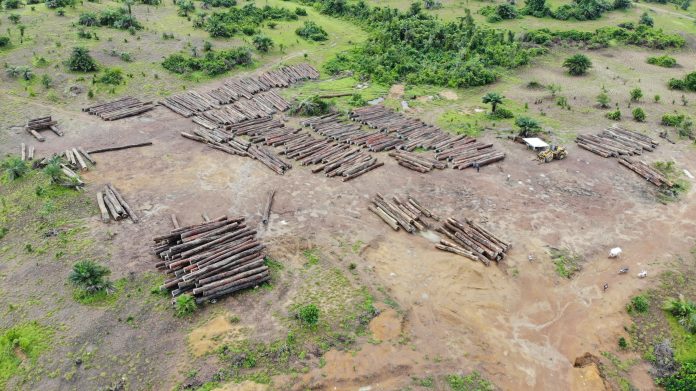
Top: Iroko logs on an open field outside of Greenville, Sinoe County. The DayLight/Derick Snyder


By Varney Kamara


MONROVIA – In this and the last three years, The DayLight published a series of reports, exposing a Nigerian-owned logging company’s offenses. Yet, the Forestry Development Authority (FDA) ignored each of the six investigations, approving the firm’s operations.

Over eight months after the newspaper’s last story, Iroko Timber and Logging Company has ceased operations. An FDA online portal identifies Iroko as “inactive.” The company is indebted to the Liberian government and the Central River Dugbe Community Forest in Sinoe, where it operated.  

“There are signs that Iroko may not return to the community. As I speak, most of their workers are now working with different companies,” said Ernest Slah, a local leader, in a phone interview. “I am seriously disappointed because the community is still struggling to get its benefits after all these big promises.”

The story started in 2022 when Iroko signed a 15 -year logging contract with Central River Dugbe Community Forest to lease 13,193 hectares in exchange for  schools, handpumps, and other benefits.

However, Iroko failed to live up to the agreement. It owes the villagers US$28,720.19 in land rental, harvesting and other fees, as well as projects, according to the community.

From their obligations to the community and the clearing of the logs from the forest, everything has been stalled since that time,” said Bartee Togba, Central River Dugbe’s chief officer. “They have still not paid the community debts they owed it.”

The FDA sanctioned Iroko’s export amid its indebtedness to the Central River Dugbe and the government, violating the Regulation on Forest Fees. The regulation requires that the FDA disapproves of an indebted company’s export.

A DayLight investigation found that a majority of the logs exported were illegally harvested and had been red-flagged by LiberTrace, the FDA tracking system.

Official records show that from July to August last year, Iroko paid the government US$173,432, covering export, land rental and other fees. The evidence, however, shows that the company owed the government US$16,263 in land rental fees.

That August, Iroko asked the Liberia Revenue Authority (LRA) to pay the balance due September and October, official records show.  

“If we default on this agreement, our tax debt may be referred to the Ministry of Justice to sue for the unpaid tax and or court’s authorization to seize and sell our property,” read Iroko’s commitment.  

The LRA agreed, but the money has not been paid, according to official records. Iroko and the LRA did not immediately respond to queries for comments.

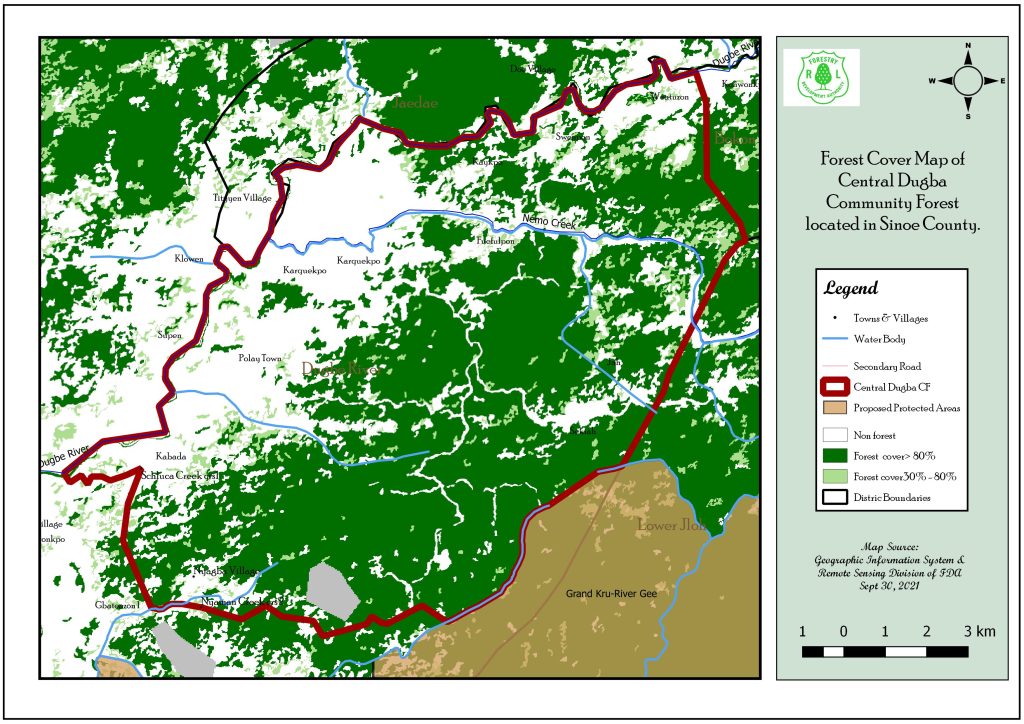
A map of the Central River Dugbe Community Forest. Filed picture/Forestry Development Authority

Another DayLight investigation last year established that the  FDA permitted Iroko to export abandoned logs without fining the firm. Thus, the government lost over US$100,000 in fines, based the Regulation on Abandoned Logs, Timber and Timber Products.

In fact, Iroko was not qualified for Central River Dugbe Community Forest due to its shareholder Timothy Odebunmi.

Odebunmi is also a shareholder in Akewa Group of Companies, which was fined US$1,000 for forging a tax clearance in 2019. The Regulation on Bidder Qualifications restricts a person who is part of a dishonest company from forestry activities for five years.

Back in Sinoe, Togba and other locals brace for a court action.

“It is a sad thing to hear this because Iroko is still obligated to the community. It owes the community numerous benefits that have not been settled,” said Togba.

“If the company decides to close and leave the community without settlement, we will use the law to demand our social and financial benefits.”


This was a production of the Community of Forest and Environmental Journalists of Liberia (CoFEJ) production.

Shady Company Gets Logging Greenlight

#image_title

Top: An operator in a Sinoe County Forest in 2017. Picture credit: James Harding Giahyue


By Varney Kamara


MONROVIA – Forestry authorities have approved a logging contract for African Finch Logging Limited, despite the company’s unknown ownership and link to a Sinoe lawmaker.

Following The DayLight series in April and May, African Finch operations appeared to have been temporarily halted. However, some five months later, it is on the verge of harvesting logs in the 18,000-hectare forest.

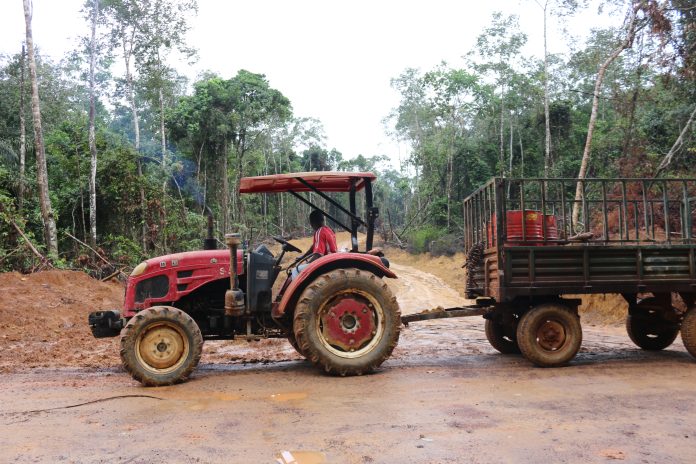
In a video, an African Finch earthmover is seen making a road in the Numopoh Community Forest, while two Asian men supervise. Also, Forestry Development Authority (FDA) records show that the company paid US$500 for timber identification tags.

This development indicates that the FDA and the Liberia Business Registry ignored findings of a DayLight series of the company’s illegalities.  

The DayLight series found that the African Finch did not declare its owners, a legal requirement. The Business Association Law and the Beneficial Ownership Regulation require all firms to declare their ultimate beneficial owners, the people who own them. Meant to combat financial crimes and conflicts of interest, the regulation requires firms to disclose politically exposed persons.

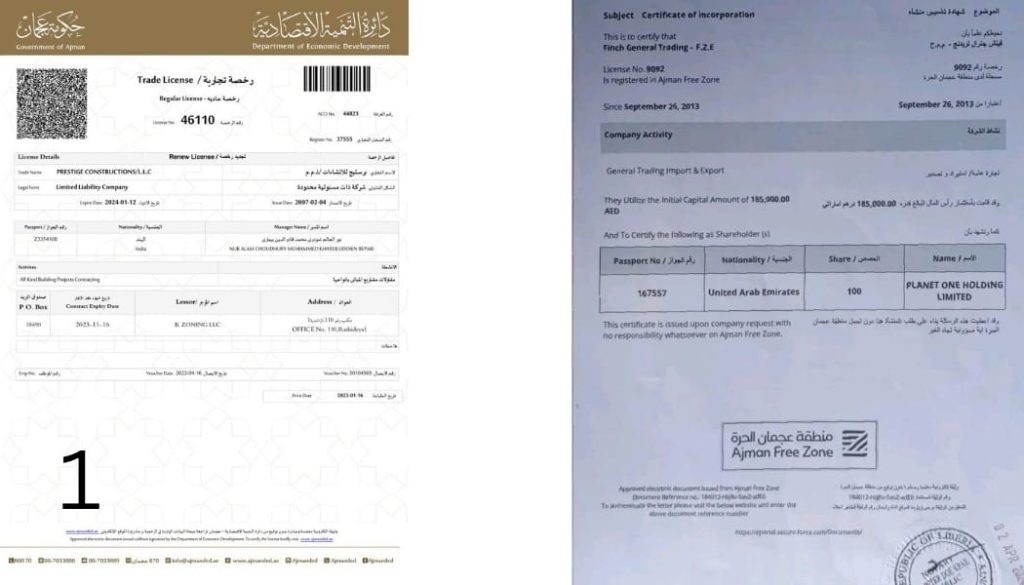
Also, The DayLight found that African Finch forged a UAE certificate, which it used to register in Liberia. 

The document in question contains a passport with the identification number 167557. However, using artificial intelligence and manual checks, reporters determined the passport did not match known samples of a UAE passport. UAE passport numbers typically consist of eight digits, including letters, and not six as on African Finch’s document.

Second, the certificate was issued by the UAE’s free-trading zone on August 11, 2020. This establishes that the certificate had expired for nearly four years when African Finch used it to register in Liberia last year.

The evidence suggests that the forgers intended to use 2020 to make the document appear legitimate. However, what they apparently did not realize was that a UAE certificate typically lasts for only a year.   

The DayLight found another inconsistency in African Finch’s purported UAE certificate. The document lacks QR codes and barcodes, key features on known UAE business certificates for verifying a company’s legal status.

Hidden ownership

In its underhand filing in Liberia, African Finch names Finch General Trading, registered in the UAE free-trade zone, as its parent company. The UAE free-trade zone is a red flag in itself, a haven for shell companies to avoid taxes and conceal their ownership.

But reporters established that Finch General is not even recorded in the UAE free-trade zone registry. Similarly, checks in the UAE official, general database yielded no results. Further checks in the Organized Crime and Corruption Reporting Project (OCCRP) Aleph, one of the world’s largest databases of companies, were the same.

Now, reporters turned to Finch General’s website, which is hosted by NameSilo, known to hide firms’ identities. Turns out the address on that website belongs to another company, while verification directs users to an unofficial site. Finch General restricted access to the website following The DayLight series.

Faking the UAE document constitutes forgery, a crime under Liberian law. Moreover, using that document to obtain a forestry contract constitutes perjury or lying under oath, according to the Regulation on Bidder Qualifications.  

The African Finch did not respond to queries about its concealed ownership and forged documents, and maintained that posture throughout.  

A copy of African Finch’s forged UAE business certificate on the right and a sample of a genuine Emeriti business certificate

“We don’t have any response for you,” Kwadjo Asabre, an official of the company, said in April. “We do not support mischief and dishonest publications. It’s cowardice.

“Don’t text me again.”

Similarly, the FDA and the Liberia Business Registry did not return questions about African Finch’s shadowy ownership and fake credentials. The newspaper has now filed a freedom of information request with the FDA, the beginning of a legal procedure.

Link to a Lawmaker

In August last year, the FDA approved Numopoh Community Forest’s request to terminate its contract with Delta Timber Corporation. Numopoh and Delta had signed the deal in 2016. Delta, owned by Gabriel Doe, a former presidential adviser during the Charles Taylor regime, had had unsettled debt and abandoned thousands of logs to rot.  

After terminating Delta’s contract, Numopoh signed an MoU with African Finch—but not without the help of Representative Romeo Quioh of Sinoe’s District #1.

The DayLight series revealed that Quioh allegedly coerced and bribed locals into signing the deal the same day it was introduced, violating their right to consent. Townsfolk claimed he directly and indirectly gave them L$3,000 and L$5,000. A townsman said he walked out of the signing ceremony in disagreement with Quioh.

Townspeople alleged Quioh brought African Finch to Numopoh in fulfillment of an election pledge to bring jobs to his constituency.

“This whole thing is part of that big promise he made to the community during the campaign,” said Alex Sanwon, a prominent Johnny Town resident.

The series determined Quioh was involved in a conflict of interest due to his connection with African Finch, a breach of the Code of Conduct for Public Officials.

Asabre, the African Finch executive, at least confirmed Quioh’s control of the company. He had told The DayLight in April to “Speak to [the] Hon” in response to company-related queries.

In an April Facebook post, Quioh denied that he had coerced or bribed the townspeople, but admitted to having a connection with the company.  

“As… a member of the advisory board of the Board of Directors of African Finch Incorporation, my involvement in forestry-related matters is strictly within the confines of my legislative oversight responsibilities,” said Quioh in the post.

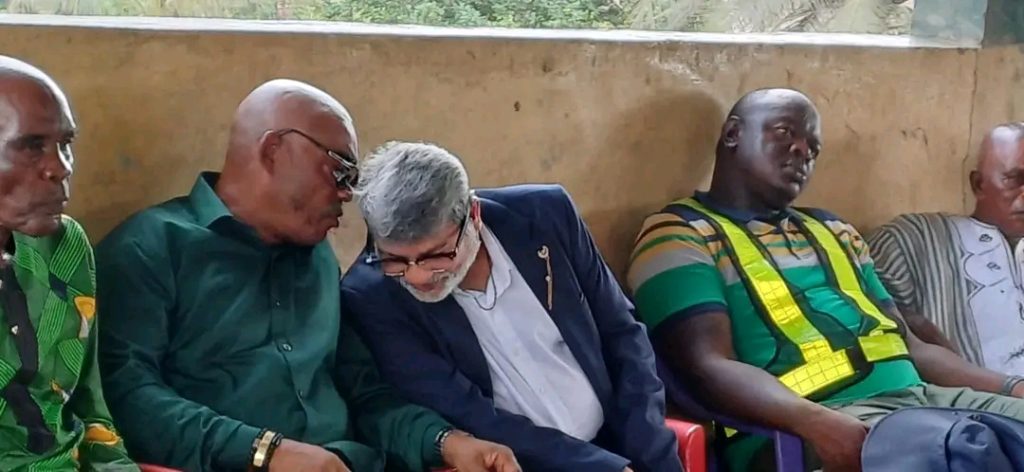
Representative Thomas Remeo Quioh converses with an African Finch executive in Numopoh. Picture credit: Anonymous

Quioh’s admission added to African Finch’s hidden human owners and the company’s unproven UAE status, leaving more questions than answers.

But before the dust settled on his admission, Quioh retracted his comments. He now claimed he had mistakenly written African Finch in the Facebook post, instead of Numopoh. He would omit “African Finch” and add “community forest management committee” to revise his rebuttal.  

But the evidence contradicts Quioh’s claim. He mentioned multiple times in the Facebook post that he was an African Finch advisor, which is inconsistent with a mistake.

There were other inconsistencies in his retraction, too. A community forest management committee or an adviser does not exist in community forestry. What exists is an executive committee that supervises the daily activities of a community forest, of which a lawmaker is a member.

When contacted on African Finch’s operations amid its legal woes, Quioh declined to speak.


“Nothing… take any action deemed appropriate,” he said, before pulling a page from Asabre’s playbook. “Going forward, please don’t ever call me on any issues regarding African Finch and its activities.”

Illegal extension

The investigation revealed that the FDA extended the community forest from 7,200 hectares to 18,000 hectares without the participation of Numopoh’s neighbors, Tartweh, Wedjah and Wolee.

Excluding neighboring communities from the expansion violates the Community Rights Law of 2009. The law requires the FDA to notify affected communities, make radio announcements, and set aside 30 days for Numopoh and its neighbors to cut their boundaries and map Numopoh’s forestland. There is no evidence that those conditions were met.

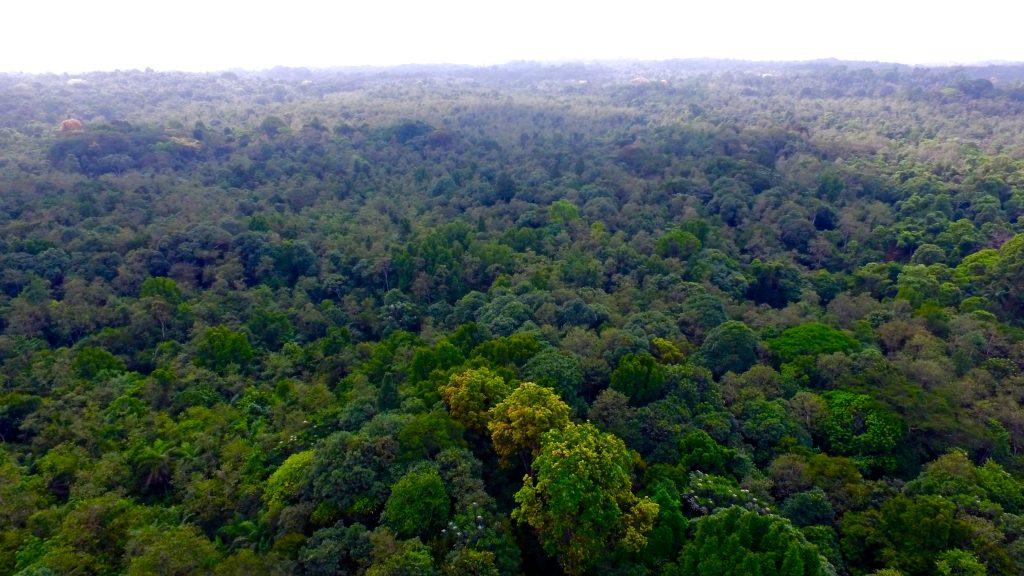
A pictorial view of the Numopoh Community Forest in Sinoe County, southeastern Liberia. The DayLight/Derick Snyder

Kwankon Saytue of Tartweh-Drapoh Community Forest said, “I only got to know about the expansion from the signed MoU when somebody posted it on social media.”

Wolee, one of three sections making up the Du-Wolee Township in the Kpayan District, is taking action against the arbitrary extension.  Numopoh and Du-Wolee are already locked in a decade-long dispute over a 463-hectare farmland, all three communities are claiming.

“We have protested about infringement on our land, and we asked them to stop,” said Abel Nyenswah, sectional head of Wolee. “The forest area the company entered belongs to us, but they are still paying deaf ears.”

Sam Kandie, a Numopoh forest leader, refuted Nyenswah’s comments, saying Numopoh had no forest boundary with Wolee. “It is a land boundary they have with Numopoh, not a forest boundary.” He did not address comments from Tartweh-Drapoh and Wedjah.


This story was a Community of Forest and Environmental Journalists of Liberia production.

Sinoe Communities Try New Conservation Method

#image_title

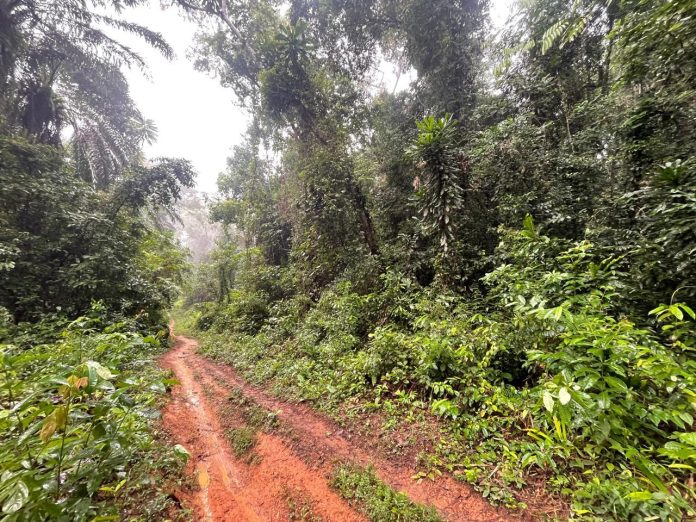
Top: A footpath inside the Lower Wedjah Community Forest. The DayLight/ Esau J. Farr 


By Esau J. Farr


GBOYEE TOWN; DIYANKPO, Sinoe County – In June, the people in Wedjah District signed an agreement with an NGO to protect 7,131 hectares of forest for yearly cash and other benefits.

“We have been waiting for this day to come for so many years,” said Savior Nyenbe, an elder of Soloe Town in Wedjah.

Two days later, the Jaedae District signed a similar agreement to keep 43,543 hectares of forest.  

“I want to say that the people of Jaedae wholeheartedly welcome the [agreement],” said Mark Toe, a local leader in Jaedae.  

The Lower Wedjah and Jaedea agreements are the first of a revolutionary approach to forest conservation in which communities receive funds for keeping their forests standing. A Paynesville-based NGO, Integrated Development and Learning (IDL), is championing the payment for stewardship.

“The agreement does not just deliver money to the community, it puts the community in charge of its own development agenda and priorities,” said Silas Siakor, IDL’s Executive Director.  

Communities own about 75 percent of Liberia’s forest. This puts local people at the core of conservation in a country that holds the largest portion of West Africa’s remaining rainforests.

The Wedjah and Jaedae agreements are a two-year trial, with a possible 25-year extension. During this time, IDL will pay Wedjah and Jaedae a combined US$152,022, with the former receiving US$21,392 and the latter US$130,630.  The first tranche would arrive this week, Siakor said.

In exchange, local people in Wedjah and Jaedae will not mine, farm, log, or build homes in their forests. They will, however, be allowed to harvest trees and other things for local development during the lifespan of the agreement.

Both communities have a rich biodiversity. Wedjah is home to several wildlife species, including chimpanzees. There are also important tree species. Jaedae, on the other hand, is part of the proposed Grand Kru-River Gee Protected Area, home to several species in West Africa.

During the trial, trained local volunteers or forest guards will conduct monthly forest monitoring. Over the years, illicit activities have undermined conservation efforts in Lake Piso, Nitrian Community Forest and the Sapo National Park next door.  A Forestry Development Authority team has traveled to Sinoe this week to train the guards. Monitoring is expected to start early next week.

Siakor believes this will not repeat in Wedjah and Jaedae. Instead, it will increase the number of protected forest areas and prevent encroachment on those forests, he says.  

“It also provides an opportunity for partnership between the community and the Wardens at Sapo, and guarantees community support for protection for the next two years.”

The trial comes at a time when commercial logging continues to fail communities. Wedja and Daedae’s neighbors, Sewacajua, Numopoh and the Central River Dugbe community forests have their share of the bad experiences.

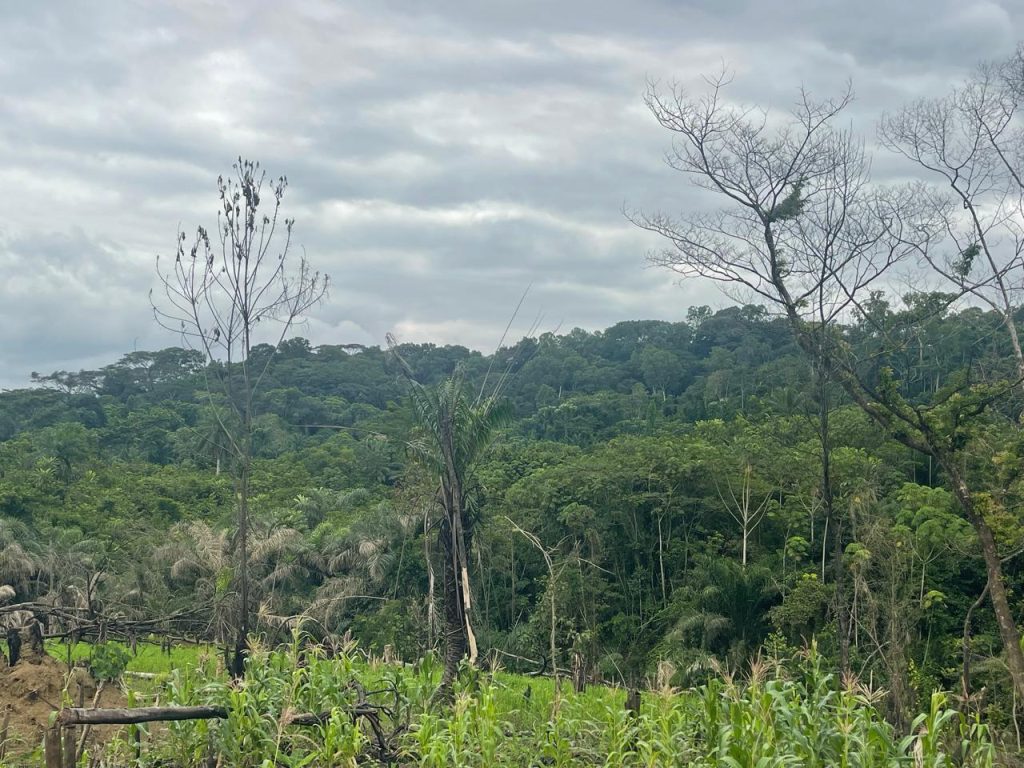
A portion of the Jaedae District forest is in the background of a farm in Diyankpo. The DayLight/Esau Farr

Also, the Burkinabé cocoa crisis in the southeast is a new challenge for conservation.

However, evidence shows that community-based conservation programs work. There are programs similar to the one in Wedjah and Jaedae elsewhere in Salayea, Lofa, Zor, Nimba, and Central Morweh, River Cess.

Campaigners say putting locals in charge of forest conservation will help Liberia meet its climate commitments, including cutting deforestation by 50 percent in 2030.  Global Forest Watch, an institution that tracks deforestation, reports Liberia lost 162,000 ha of natural forest in 2024, equivalent to 104,000 tons of carbon dioxide emissions. 

“This initiative represents a significant step forward in forest conservation efforts,” says Andrew Zelemen, a leader of the National Union of Community Forestry Development Committees. “For too long, forest communities have not received direct compensation for their role in preserving these critical ecosystems.”


This story was a production of the Community of Forest and Environmental Journalists of Liberia (CoFEJ).
Park Warden Wants 250 Armed Rangers to Protect Sapo Park

#image_title

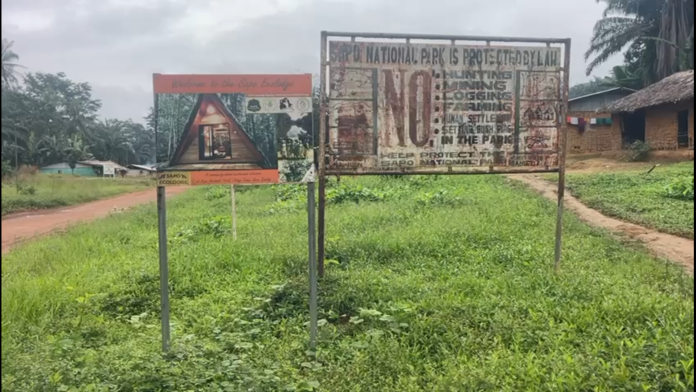
Top: A Sapo National Park signboard in Cherue Town, Sinoe County. The DayLight/Carlucci Cooper


By Varney Kamara


JAYLAY TWON, Sinoe County – The government should arm 250 rangers to protect the Sapo National Park from illegal occupants, John Smith, the reserve’s Chief Warden, has said.

Spanning over 180,000 hectares across Grand Gedeh, River Gee, and Sinoe Counties, Sapo Park is Liberia’s largest natural reserve. However, only 30 law enforcement rangers man it.

“The size of the forest tells us that the number is insufficient to protect an area of this magnitude,” Smith told a DayLight interview in Jaylay Town, the rangers’ headquarters. “This has compelled the need to increase the force so that we can effectively deal with the situation on the ground.”

Established in 1983, the Sapo National Park is a global biodiversity hotspot, sheltering 125 mammal species and 590 bird species, including several endangered species. It is the second-largest rainforest in West Africa after the Tai National Forest in neighboring Ivory Coast.

However, the park faces environmental threats from illegal logging, agricultural expansion, and mining. There are 13 known illegal mining camps in the park, predominantly occupied by miners from the West African sub-region – Mali, Nigeria, Ivory Coast, and Guinea, the report found. A 2012 report found weak monitoring and poor boundary awareness among miners as key challenges.


In May 2017, a mob of local rioters killed a ranger and severely injured four others. It took armed anti-riot police to bring the situation under control.

Taylor Kaydee, an FDA-assigned ranger in Chebioh Town, the setting of the 2017 violence, said rangers were attacked often. About a year ago, he and other rangers were attacked after they arrested some illegal miners in the park. A court in Juarzon intervened for their handcuffs to be retrieved.

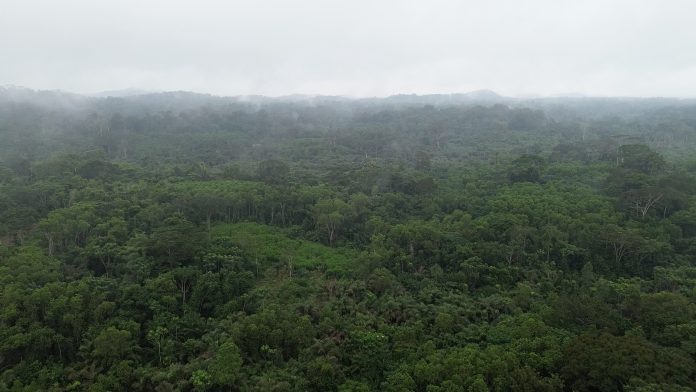
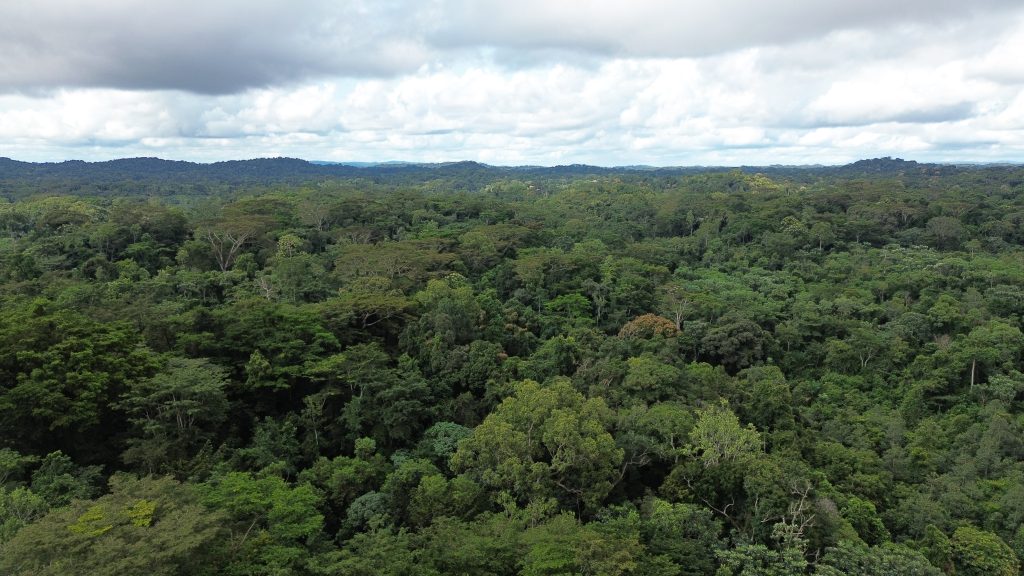
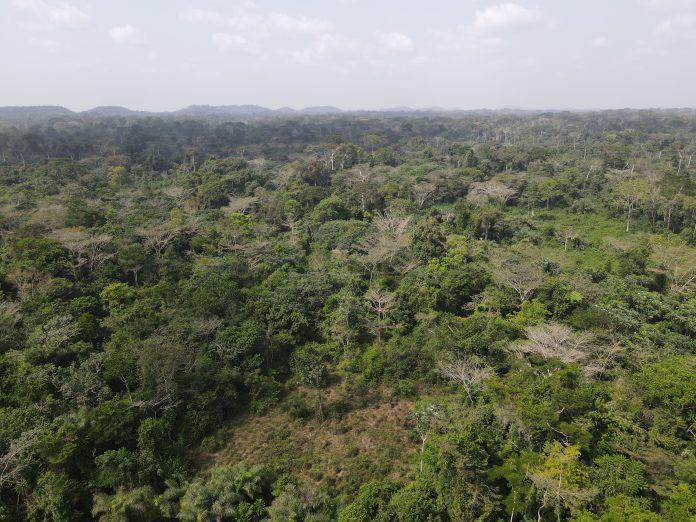
A drone shot of a portion of the Sapo National Park. The DayLight/Carlucci Cooper

“How do you go to arrest somebody who has arms in a jungle terrain of this nature, but you, who are the law enforcer, don’t have arms?” Smith asked rhetorically.  Smith added that it was impractical for unarmed rangers to protect the park against its illegal occupants, armed with single-barrelled guns. 

Security actors have been critical of arming rangers for the two decades that followed since Liberia’s civil wars ended in 2003. Critics fear arming forest rangers could lead to abuse of power, violence, and undermine reform efforts.

Smith disagrees. He believes sufficient law enforcement rangers must be trained, armed, and deployed not to shoot people but perform their tasks in line with the law.

“It is a sustainable approach that speaks to the longstanding difficulties we face over the years. We need the manpower, training, and logistics to support our security plans and operations.”

Podcasts